Wednesday, October 21, 2020

Post 5: Eight Values of Free Expression

What is Permitted Under Free Expression

The First Amendment grants five freedoms to the people, one of which is the Freedom of Expression. There are eight values to the Freedom of Expression, which include the (1) Marketplace of Ideas, (2) Participation in Self-Government, (3) Stable Change, (4) Individual Self-Fulfillment, (5) Check on Governmental Power, (6) Promote Tolerance, (7) Promote Innovation, and (8) Protect Dissent. 

1. Marketplace of Ideas (Discovery of Truth) - 

    The first value of Free Expression is the Marketplace of Ideas. It explains that through competition, superior products sell better than those which are inferior. It uses competition to judge its' reliability. Therefore, the theory criticizes the use of censorship, and instead encourages others to use their First Amendment right to express their ideas. The concept of the freedom of speech and press comes from John Milton's 1644 pamphlet, Areopagitica, that was published as a response to the Parliament restricting what can be printed. 


2. Participation in Self-Government -

    The second value of Free Expression is the Participation in Self-Government. Philosopher Alexander Meiklejohn argued that under the First Amendment, self-governance justifies freedom of speech. He additionally believed that the main purpose of the First Amendment is to ensure that voters are capable of making well-informed choices about their self-government. 


3. Stable Change (Safety Valve) - 

    The third value of Free Expression is Stable Change. This concept stems from philosopher Benedict Spinoza's Tractatus-Theologico Politicus. In it, he defends freedom of thought and expression. His ideas laid the foundation for several political societies, including that of the First Amendment to the Constitution of the United States. His idea was later adapted into the safety valve theory; a philosophical justification of the right to protest, which is heavily emphasized in the First Amendment. 


4. Individual Self-Fulfillment (Self-Actualization) - 

    The fourth value of Free Expression is Individual Self-Fulfillment. This theory comes from C. Edwin Baker's "liberty model" which was created to be an alternative to the marketplace of ideas. Baker's model suggests that the freedom of speech promotes the values of self-fulfillment and self-realization.


5. Check on Governmental Power (Watchdog Role) - 

    The fifth value of Free Expression is the theory of Checking Value. This theory, was proposed in Vincent Blasi's 1977 essay, The Checking Value in First Amendment Theory. It explains that the media has a role in the system of checks-and-balances. We (the media) essentially act as a "watchdog" to the government. 


6. Promote Tolerance - 

    The sixth value of Free Expression is the Promotion of Tolerance. Lee Bollinger proposed this theory in his 1986 essay, The Tolerant Society: Freedom of Speech and Extremist Speech. Bollinger explains that freedom of speech normalizes extremist speech and protects it, allowing for society to form their own norms on what is and is not okay to say.


7. Promote Innovation - 

    The seventh value of Free Expression is the Promotion of Innovation. This theory was proposed by Jack Balkin in his book, Living Originalism. In it, he claims that communities in which free speech is valued and protected are more diverse, due to the idea that people feel more inclined to express their own opinions.


8. Protect Dissent - 

    The eighth and last value of Free Expression is Protecting Dissent. Steven Shiffrin, in his book, Dissent, Injustice and the Meanings of America explains that our system is not supposed to be that of a "mob view." Instead, he argues that we have the right to criticize the government; that it is in fact, our patriotic duty to do so.

Sunday, October 4, 2020

Post 4: Anti-War

Antiwar Voices: Are They Being Suppressed? 

After looking at the website ANTIWAR.COM, I noticed that it was very sketchy-looking. Just to be safe and make sure that I would not get a virus on my computer, I looked it up on Wikipedia. Surprisingly enough, I found information about the website. According to the Wikipedia article, the site was founded in 1995; which explains its' sketchy appearance. It was founded as a response to the Bosnian war, and their first objective was to "fight against intervention in the Balkans under the Clinton presidency." 


As for the American Conservative website, it appeared less sketchy. The Wikipedia article mentions that it was founded in 2002 in opposition to the Iraq War. The website itself states that it is not about debt and warfare, but about "liberty, localism, a strong middle class, staying out of foreign wars in which American interests are not at stake."

Prior to exploring these websites, I have never really heard strong antiwar voices. In fact, I never heard of either the sites. I believe that the reason antiwar voices are suppressed is due to the idea that being antiwar is unpatriotic. The United States was founded from a war, and we often celebrate war as well as our military. Personally, I believe that antiwar voices should not be suppressed. Instead, I believe that they should at least be acknowledged, which would help in supplementing the idea that everyone's voices are heard.

Thursday, October 1, 2020

Post 3: The First Amendment

  Black Lives Matter: Is it Political?

On February 26, 2012, 17-year-old Trayvon Martin walked into a 7-Eleven in Sanford, Florida wearing a dark gray sweatshirt with a hood over his head. He bought a bag of Skittles and Arizona tea and walked out. Although this is a seemingly innocent thing to do, it is apparently unlawful for a young black male to buy a snack from a convenience store. While walking back home, the neighborhood watch volunteer, George Zimmerman, noticed Martin and decided to call 911 to report his "suspicious" behavior. Zimmerman is instructed to not approach Martin, however, he does so anyway. Out of "self-defense," Zimmerman chooses to shoot and kill Martin. 

As a response to this tragedy, the Black Lives Matter movement was founded, whose mission is to "eradicate white supremacy and build local power to intervene in violence inflicted on Black communities by the state and vigilantes." 

As more innocent Black lives are being taken, the Black Lives Matter movement has been growing. The growth of the movement has also lead to a growth of backlash, as people make the false accusation that it is a hate group. 

Under the First Amendment to the United States Constitution, freedom of speech and the freedom of expression is guaranteed to all citizens. This means that movements, such as the Black Lives Matter movement is protected under the First Amendment. 

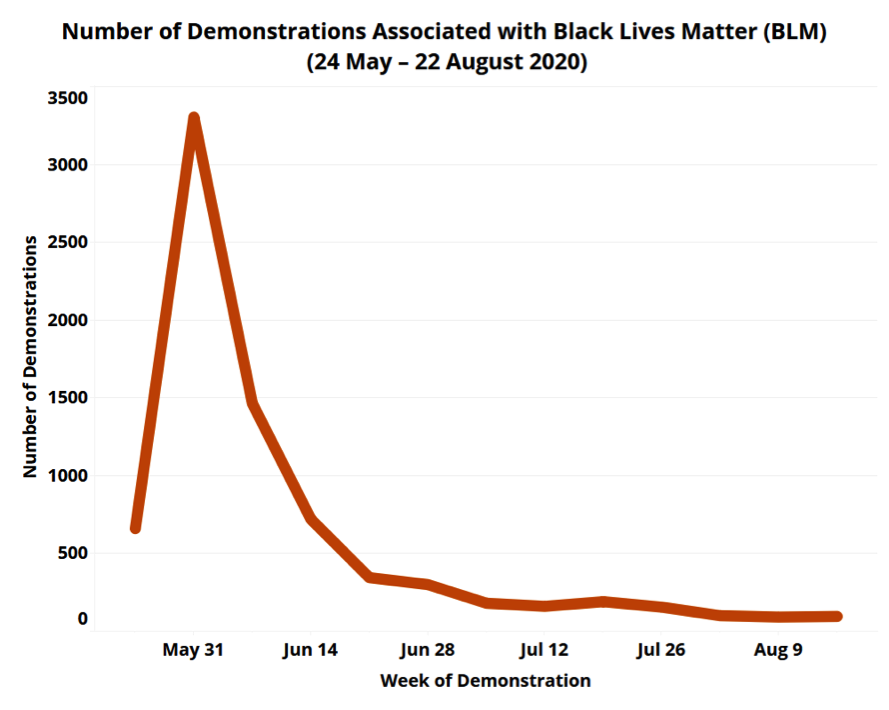
Although protests organized by the Black Lives Matter movement have the reputation of being violent, the Armed Conflict Location & Event Data Project (ACLED) analyzed more than 7,000 demonstrations between May 26 and August 22, 2020 after the murder of George Floyd. Of course, the 7% of protests that have induced violence are not protected. 

Nevertheless, it is important to hear and listen to the Black Lives Matter movement. Even if you have a different opinion, it is necessary to listen to others in order to help end discrimination in both the U.S. and the world as a whole.


Monday, September 21, 2020

Post 2: The Supreme Court

The Supreme Court of the United States

History

    The Supreme Court of the United States, otherwise known as SCOTUS, was established in 1789 under Article Three of the U.S. Constitution. It is the highest federal court in the country as well as the head of the government's judiciary branch. Due to its' power, the Supreme Court has the capability to evaluate all laws. Additionally, under the system of Checks and Balances, the Supreme Court can "check" the actions of the other two branches of government. 

   Article Three of the U.S. Constitution allowed Congress to decide how the newly established Supreme Court would be organized. Along the creation of the third article of the Constitution, the Judiciary Act of 1789 was drafted and signed into law by George Washington. The law specified that the Supreme Court would be made up of six justices who would serve until their death or retirement. 

    The Supreme Court was scheduled to first assemble on February 1, 1790 in New York City, however, it had to be postponed to the next day due to unforeseeable circumstances. It was not until August 3, 1791 that the Supreme Court made their first decision in the case West v. Barnes. 


The First Justices

    The first Supreme Court was made up of chief justice and founding father John Jay, along with John Rutledge, William Cushing, John Blair, Robert Harrison and James Wilson. The chief justice of the Supreme Court is responsible for being the head of the court and is required to sit on the Board of Regents of the Smithsonian Institution.


Over the years, Congress changed the number of justices in the Supreme Court. In 1869, they settled with nine justices, which is the current set amount today. The current Supreme Court consists of chief justice John Roberts, Jr. and associate justices Anthony Kennedy, Clarence Thomas, Stephen Breyer, Samuel Alito, Sonia Sotomayor, Elena Kagan, Neil Gorsuch and the late Ruth Bader Ginsburg. 


Conclusion

    As U.S. citizens, it is necessary to understand the importance of the Supreme Court as well as how it works. I hope to continue expanding my knowledge on the Supreme Court as well as the justice system in the United States as a whole. I additionally hope that in the future we will see a more diverse Supreme Court, allowing for minority groups to feel represented. 


Thursday, September 17, 2020

Extra post 1: Masks

How to Correctly (& Efficiently) Wear a Mask

    At the start of the COVID-19 pandemic, the World Health Organization (WHO) advised that only those who have the virus or are taking care of someone who does should wear a mask. However, as more information on the spread of the virus became available, both WHO and the Centers for Disease Control and Prevention (CDC) changed their stance and began to recommend the use of masks for everyone. As of now, we have more information on the virus than before. Nevertheless, people are still refusing to wear a mask the right way. Currently, the US is leading the world with a whopping 6.5 million cases and nearly 200 thousand deaths. A number that is still growing due to the re-opening of states and the lack of proper mask-wearing. 


Since many people cannot figure out how to wear a mask the right way, I thought I would include a step-by-step tutorial on how and when to wear one:

Step 1.  Take note of your surroundings. 

      Are you in a public place or cannot distance by 6 feet? Wear a mask. Are you near others who do not live with you? Wear a mask. Have you been exposed to someone who tested positive? Contact your local health provider and stay home for at least fourteen days.


Step 2. Check to see if your mask is effective


Does your mask fit one of these descriptions provided by the CDC? It is advised not to wear one, since the efficiency is currently unknown. 


Step 3.  Check to see if you are wearing it correctly

   This part is definitely the hardest! Make sure your mask covers your mouth, nose, and chin. Refrain from wearing it like how the people in the infographic below are.


Step 4. Celebrate!
    
    Congratulations! You are now able to correctly wear a mask! Well done.


Thursday, September 3, 2020

Post 1: My Top 5 News Sources


                      TOP 5 NEWS SOURCES


The internet can be a great tool to use to quickly find information and learn about what is going on in the world, but it can also be a hassle to find credible and unbiased sources. Fortunately for me, I grew up with technology, which has allowed me to take note of credible news sources over the years.

Here is a list of my personal top 5 sources I receive my news from (in no particular order):


1. Twitter


Yes, you read that right. I know it sounds kind of ridiculous, but one of my favorite places to get news from is Twitter. It is certainly not always accurate, but it allows me to hear about events as soon as they have happened. Additionally, I can read opinions from several people, including those who have actually witnessed the event. Though the idea of getting real-time news can be beneficial, it also has the disadvantage of having uncensored content that people may find triggering.

Summary of pros:
  • Real-time news
  • Various opinions 
  • Easy-to-read
  • Accessible
  • Not super wordy (limited to 280 characters)


Summary of cons:
  • Potentially triggering content 
  • Anyone can write something
  • Not always accurate
  • Not an actual news website 
  • Lots of distractions


2. The New York Times


Another one of my favorite sources is The New York Times. As for reliability, it is much more reliable than Twitter. It is also useful if you want to hear more one-sided opinions, as it leans slightly left on the political compass. I typically check The New York Times after I read about an event on Twitter to gain more insight. On the contrary, the articles are not necessarily published in real-time, since they are written by professional journalists. It is also less accessible than Twitter, you have a limit of five articles per month before you have to buy a subscription.

Summary of pros:
  • One-sided opinions
  • Written by Professional Journalists
  • Well-established news source
  • Actual articles


Summary of cons:
  • Takes longer to write articles than Tweets
  • Limit of five free articles per month


NBC News is another reliable, but slightly left-leaning news source that I like to use. It is the primary news channel my parents watch, so I basically grew up with it. Since my parents trust it, I feel like I can trust it as well. There are two main television programs from NBC that I consume; Nightly News and WCNC. Nightly News looks more into world events, while WCNC is my local news program, talking about things going on in and near Charlotte (where I am from). Although NBC News also has a website, I prefer watching the news rather than navigating through the website to gain information.

Summary of pros:
  • One-sided opinions
  • Can watch it on TV
  • The chime is iconic and fun to listen to
  • Can lead to family discussions 


Summary of cons:
  • Website hurts my brain (a bit too much to look at!)

4. Charlotte Agenda


Another local news source I like to use is the Charlotte Agenda. However, unlike the other news sources, the Charlotte Agenda has more than just news. It is more like a magazine, as it highlights a few things to do in and around Charlotte. Even with COVID-related restrictions, it still features new things that are happening in Charlotte, which is nice to read through especially now.

Summary of pros:
  • Features fun things to do
  • Neat website
  • More than just news

Summary of cons:
  • Makes me a bit homesick


I typically would not use the CDC as for a news source, however, due to the current COVID-19 pandemic, I have been more inclined to check the CDC website for any Coronavirus-related statistics. I have not been checking it as often as I had been during the beginning of the quarantine in the United States. Additionally, I do not really like checking it because it is quite frightening.

Summary of pros:
  • Government-based organization
  • Accurate statistics

Summary of cons:
  • Not fun to read
  • All data is health-related 

Honorable Mention:

The Onion

It might be a satirical news source, but it is fun to read articles and watch videos from The Onion. It is especially fun to read the comments on their YouTube videos of people who believe it is a legit news source. 

Summary of pros:
  • Humor
Summary of cons:
  • Some of it is a bit too realistic
  • Not everyone knows it is a satirical website


Did your most used sources make the list? Let me know!